Lanbrukarnas Riksförbund (LRF)
When we at Toxic were tasked with redesigning The Federation of Swedish Farmers' (LRF) current website, we began to clarify what challenges LRF saw with the existing website and where the focus should be for the new website.


The challenge
LRF emphasised that their top priority was putting members at the centre. They also wanted to modernise the design, improve performance and focus on usability.
LRF wanted to put its members at the centre, but the existing website limited the organisation’s ability to develop the digital experience. The site was built on Episerver and had accumulated technical debt over the years. This was evident in long loading times, particularly in the self-service tools, as well as shortcomings in the search functionality.
Forms were another recurring issue. The membership sign-up process was perceived as complex and inflexible and could not be adapted to new membership recruitment goals, an area that was a high priority for LRF. The organisation wanted to build a new membership journey with supporting campaign pages, while reducing its reliance on physical member services by enabling more tasks to be handled directly on the website.
Internally, the tools for elected representatives stood out as one of the most critical areas to get right. Reporting on the year’s activities, electing board members, submitting motions and creating activities for members are among the website’s most important functions, and they needed to become both more intuitive and efficient to use.
LRF is also an organisation with several geographical levels, from the national federation and regions to municipal branches, local branches and local groups. With editors located across the country and varying levels of technical expertise, the new platform needed to be easy to work with.

About LRF
The Federation of Swedish Farmers, LRF, is a politically independent business and interest organization for people and companies within the green industries. LRF contributes to the development of businesses and entrepreneurs based on agriculture, forestry, gardening, and the rural environment, so that they can realize their ambitions for growth, profitability, and attractiveness.
The solution
The project was divided into two phases: phase 1, preliminary study, and phase 2, implementation and development. During the first phase, we defined the vision, target groups and impact goals, among other things. Together, Toxic and LRF decided to build a website that enables personalised communication and audience targeting, provides a platform for elected representatives and tools for editors, and creates a more efficient journey for members. A new visual identity was developed, followed by a prototype of the new website.
In phase 2, we shifted our focus to the technology. LRF has many systems that need to communicate with each other, making stable technology essential for creating a sustainable website, both now and in the future. We built the site on Umbraco and Microsoft Azure, providing a high level of control, full flexibility and 100% scalability. To further improve stability and speed, two servers perform the same tasks through load balancing. As part of the development, we implemented 15 different integrations, including ImageVault, BankID, Swedbank Pay and Swish, which connect to external systems, as well as Freshdesk, Roten and Samköp, which integrate with LRF’s internal systems.
A modern website built around members’ needs
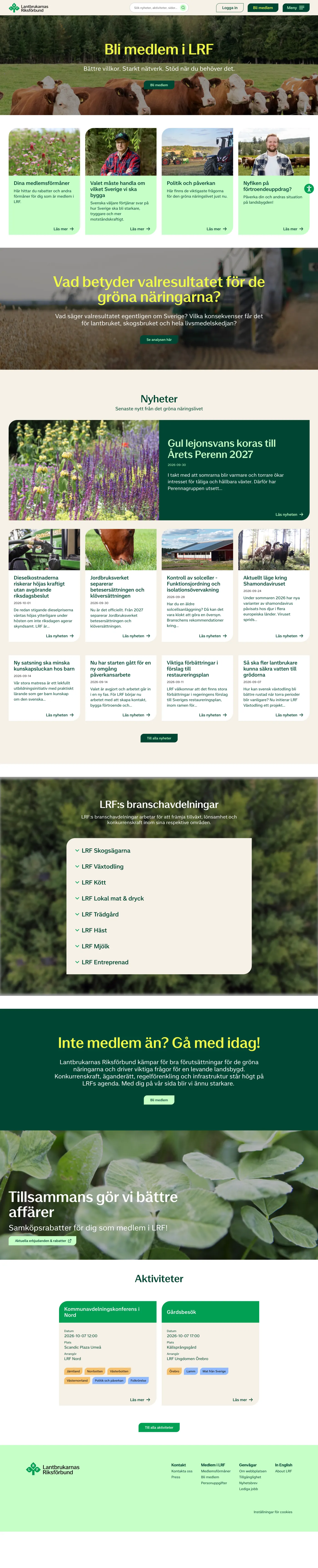
The result of the collaboration was a modern and user-friendly website designed around the needs of both members and editors. The site offers personalised communication based on interests, a logged-in environment for elected representatives and tools for editors. The new design and functionality create seamless user journeys, from logging in with BankID and paying membership fees easily through Swish or Swedbank Pay to tailoring content based on individual interests and needs.
We have continued to support LRF since the launch through regular two-week sprints and well over a thousand completed development tasks. The membership journey, which was previously perceived as complex and inflexible, has been rebuilt to make becoming a member easier and complemented with new tools for collecting leads from potential members. The search functionality, which previously had significant shortcomings, has been equipped with a new search engine tailored to LRF’s needs.
Continuous development of the platform
The self-service tools for elected representatives have both been improved and expanded, while the tools available to editors have been further developed with customised sections in the Umbraco backoffice. The platform is also continuously updated to new versions of Umbraco to avoid accumulating the same technical debt as before. LRF’s statistics, which were previously collected in a complex Excel spreadsheet, are now presented directly on the website through a custom-built feature that imports and visualises the data.
The site has also gained new content blocks and page types, providing more ways to present information, and has been fully rebranded to reflect LRF’s new brand identity. A large number of the development tasks involve smaller improvements, bug fixes and adaptations, both large and small. This says something about the nature of the collaboration between Toxic and LRF: it is not a one-off project, but a long-term relationship.

Book a meeting
In the meeting, we will go through your goals, current situation, and how we can assist you further.
More references

AmpSociety
Toxic has had the privilege of collaborating with AmpSociety in their effort to digitize their entire business flow, everything from project support, product configuration, quote management, and order placement of Amp's new charging system Amp5. The result is a new dealer portal, AmpPortal, which makes it easier to plan, configure, and order charging systems. The platform streamlines the work for sellers, dealers, and installers throughout the process, from early planning to final order.

Logistri
Before its planned listing change to Nasdaq Stockholm's main list, Logistri faced increased demands for transparency, reporting, and accessible investor information. Together, we developed a modern IR platform in Umbraco that simplifies daily operations and creates a stable foundation for the next phase of the company's development.

Länsförsäkringar Fastighetsförmedling
We at Toxic are proud of our long and successful collaboration with Länsförsäkringar Fastighetsförmedling, which we have had the privilege to work with since 2016. Together, we have created a modern website built in Umbraco, focusing on user-friendliness, attractive packaging of property information, and continuous improvements. Our joint work is characterized by innovation and sustainability, always with the users' needs at the center.

Essem Design
Essem Designs e-commerce is the flagship store where user experience, design, and the brand's history are highlighted in every detail. Together with Toxic, Essem has taken the step to a global platform where the vision of the hall as the "first room" meets modern technology, high performance, and a long-term digital strategy. Through a new framework, inspiring features, and over ten years of SEO work, Essem has created a digital presence that drives growth both in Sweden and internationally.

Svegro
Toxic proudly presents our latest client case: a complete transformation of svegro.se. With a focus on modern UX/UI design, a stable platform in Umbraco, and innovative features, Toxic has created a digital platform that not only enhances Svegros brand awareness but also inspires a sustainable life with organic farming. The new website offers an enhanced user experience that reflects the 'wow' feeling Svegro is known for.

Kläppen Ski Resort
We at Toxic were entrusted to help Kläppen Ski Resort at a strategically important stage, where their existing web platform needed to be reviewed for the future. Kläppen's previous website was built in Episerver, with a license that expires in 2026. This created a clear need to find a new solution that was both sustainable in the long term and cost-effective.

Konradssons Kakel
Konradssons Kakel wants to be the obvious choice for craftsmen and make it easy for all customers to find the right one. Together with Toxic, they have built a new website in Litium and a B2B e-commerce for resellers and professional customers. At the same time, a long-term SEO effort is underway that allows more people to find it via Google.

Bevent Rasch
An e-commerce platform with increased service level and accessibility was on Bevent Rasch's wish list, and that is also what their new e-commerce, built by Toxic, achieved. With web, e-commerce, and PIM on the same platform – Litium – the customer experience improved while the administrative and manual tasks were streamlined.

KABE
We at Toxic are proud to have been entrusted with developing KABE's new website. The project combines modern design, improved user experience, and an editor-friendly CMS, Umbraco, to best meet KABE's needs.

GARO
GARO needed a new site to take the next step in its digital journey and to offer both of its target groups; the private consumer and the electrical installer a modern digital experience. Toxic built the solution in the e-commerce platform Litium.

Infranord
Toxic has developed digital solutions in close collaboration with Infranord that strengthen both their internal efficiency and external brand. By creating the customized mobile app TORD and redesigning the website in connection with Infranord's rebranding, we have together created a comprehensive solution that supports their operations – from technology to communication.

Svensk Camping
Svensk Camping, formerly known as SCR, underwent a comprehensive rebranding. In connection with the launch of a new graphic identity, Toxic was tasked with developing a new website built on Umbraco Cloud. The result is a modern and informative digital platform that strengthens Svensk Camping's communication and creates better reach for both the industry and the organization's members.

Norrviken
When Norrviken wanted to strengthen its digital presence, Toxic was entrusted to create a unified web platform, built in Umbraco, that elevates their entire operation – with the park and visitor experience at the center. The new solution makes it easier to inspire, inform, and guide visitors year-round. As part of the platform, Toxic has also developed an e-commerce solution in Umbraco Commerce, integrated with the business system HiCore via our integration engine EntityFlow.

Stolab
Toxic has long had a close collaboration with Stolab and has been their digital partner. The collaboration has now led to Toxic, together with Stolab's in-house department, creating a comprehensive solution with a focus on sustainability.

Ravema
To streamline their order management and consolidate their large product range under their own ownership, Ravema needed a complete e-commerce platform. Together with us at Toxic, they took the step to a solution that is not only integrated with their business system but also provides their customers with a simple and smooth shopping experience.

Isaberg Mountain Resort
Isaberg, one of Sweden's premier destinations for outdoor activities and skiing, has developed a modern digital platform in collaboration with Toxic to enhance its online presence and optimize the customer experience. The platform integrates several booking systems and customizes content based on the season, making it easier for guests to find and book activities. In this case, we focus on how the new solution has created a smoother and more cohesive experience for Isaberg's visitors year-round.

Miller Badrum
We proudly present our comprehensive solution for Miller Badrum's new digital platform. With Litium CMS, PIM, and Commerce, we at Toxic have created a mobile-friendly and dynamic e-commerce solution that makes it easy for customers to configure bathroom furniture and explore a wide range of products. The new platform streamlines Miller Badrum's product and content management while enhancing the brand's presence and creating an inspiring experience for both Nordic and British customers.

Furhoffs
Furhoffs Rostfria needed a modern B2B e-commerce platform that could handle complex product configurations and streamline order flows. Toxic developed a customized solution based on Litium with integration to the business system Monitor G5, which among other things solves automated management of prices, inventory levels, and customer-specific agreements. The result is a scalable e-commerce platform with improved UX, faster order processing, and search engine optimized product structure – tailored for industrial sales online.

Pulsen Fastigheter
Pulsen Fastigheter needed a new website that better reflected their business and commitment to Borås. With a new, modern, and flexible solution in Umbraco, they now have a platform that is easy to update and provides a better user experience for both tenants and visitors.

Gnosjö Automatsvarvning
Gnosjö Automatsvarvning has initiated a digitalization project with us at Toxic to develop System ONE – a platform that will streamline internal processes and complement the company's existing systems to meet future needs. As the first step, a presence module is now operational, which improves safety and efficiency in the business. In this case, we focus on how this subproject within System ONE has helped Gnosjö Automatsvarvning to digitalize its attendance management.

Cynca Nordic
Cynca, an industrial group within sustainable and socially critical infrastructure, needed to streamline the management of reports and press releases. By building their website in Umbraco and integrating with Modular Finance, Toxic created a solution that saves time, enhances security, and provides a smooth user experience. Toxic is also continuously working to further develop the website to meet Cynca's growing needs and ensure that it always maintains the highest standards.