Where the ridge meets the sea – the story of Norrvikens trädgårdar


There are places that do something to you even before you understand why. Norrvikens trädgårdar on the Bjäre Peninsula is one such place. Here, where Hallandsåsen meets the sea and a favorable microclimate allows the impossible to bloom, a man's vision has lived on for over a hundred years; through storms, crop failures, changes of ownership, and a period of decline that almost became the end – but it did not.
A pomologist's dream that became a cultural heritage
The story begins with Rudolf Abelin, a pomologist and visionary, who in the early 1900s was in search of land for his apple orchard. When the Swedish railway laid its tracks straight through his property in Norrköping, he was forced to rethink. Rudolf moved in the society of his time in and around Båstad, and in 1905 he traveled to the Bjäre Peninsula to see what is today Norrviken with his own eyes. The following year, he bought the entire area and named it Norrviken.
His vision was as ambitious as it was poetic: apple orchards and hazelnuts embedded in a park where garden art could speak through contrasts. Wild plants next to shaped ones. Soft lines against hard ones. Style gardens inspired by different eras and countries – each with its own character. Rudolf designed most of it himself, and it is largely his sketches that are still visible in the park's structure today.
The apple orchard was to finance the dream, but nature had other plans. Crop failures and harsh storms hit hard, and Rudolf was eventually forced to leave Norrviken. By 1920, the park had opened to paying visitors – that was when Norrviken became a garden park. The shipping company Norrstjärnan took over, and since then the place has passed through several owners' hands.

One of the buildings on the site, where today's visitors are welcomed into the restaurant's bright room | Photo: Hannah Sundberg

Painting of Rudolf Abelin | Photo: Hannah Sundberg

Much of what is seen in the park today follows Rudolf Abelins original sketches | Photo: Hannah Sundberg
Resurrected from decay
"It was in a state of disrepair ten years ago," says Maria Höjer, marketing manager at Norrvikens trädgårdar. She recounts it without drama, as a fact that makes the present all the more remarkable. Norrviken is today part of the Backahill group, and it is thanks to the generous investments of the Pålsson family that the site has been restored. Original paintings have been restored, and the gardens, which were severely dilapidated, have been worked back with respect for Rudolf's original vision.
"Cultural heritage is something we cherish and take care of, but we want it to move forward and develop – with respect for the heritage," says Maria.
It is a balancing act that permeates everything: to manage without conserving. To develop without losing.
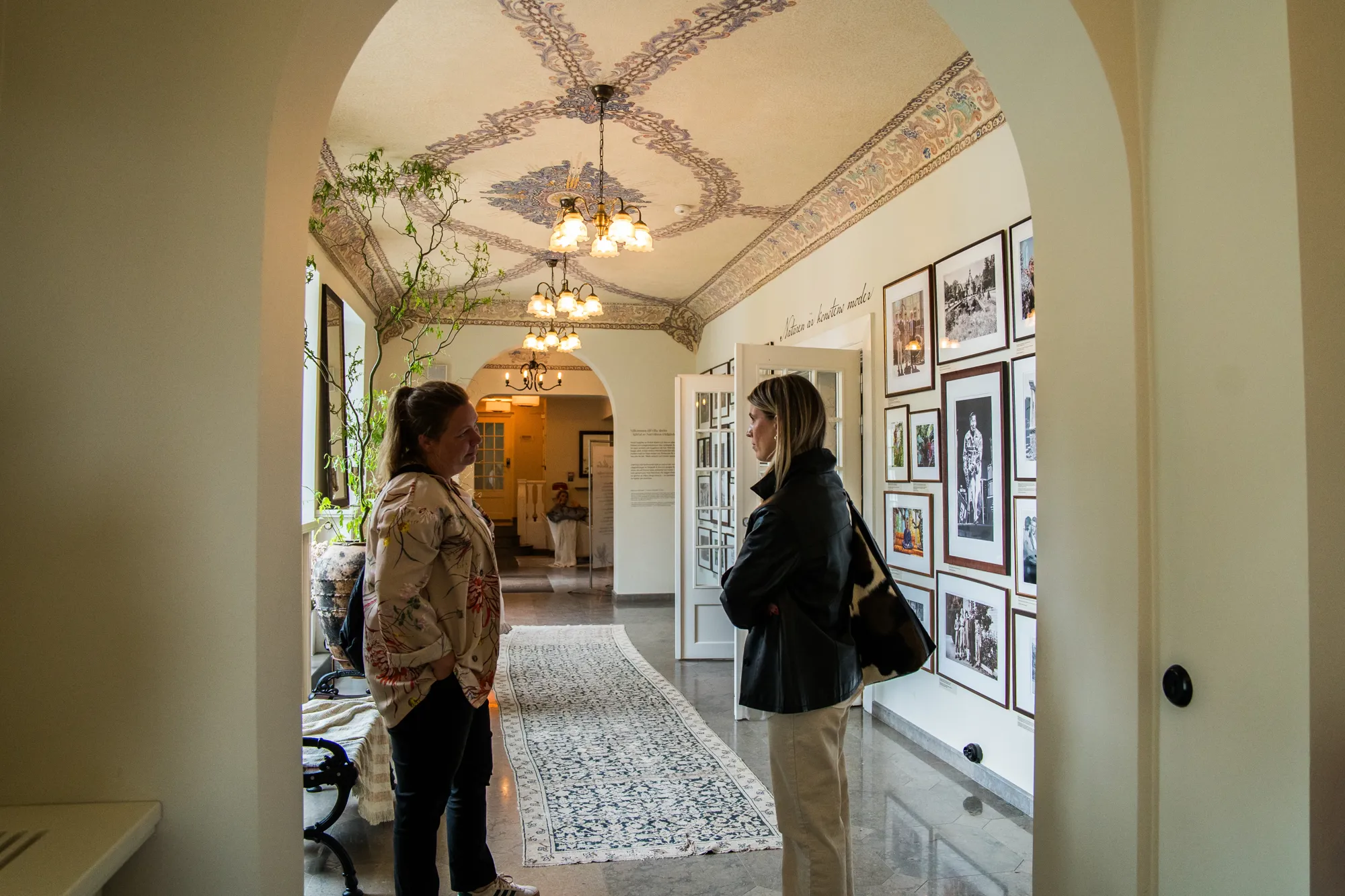
Maria Höjer and Mirjam Lewin in Villa Abelin, surrounded by restored original paintings | Photo: Hannah Sundberg
The Contrast as a Guiding Principle
When I ask Maria what makes Norrviken special, she takes a small pause before answering. "It's this vague thing – the place itself," she says, meaning it as a tribute. Partly, it's about the physical aspect: the location where the ridge meets the sea creates a climate that is unusually favorable for cultivation and provides a vegetation that few places in Sweden can match. It is evident everywhere, in how the gardens change character with the seasons and in how the wild and the cultivated coexist side by side.
Equally, it is about the garden philosophy that Rudolf Abelin once formulated and which still permeates the daily work. The core of his thinking was contrasts: the large against the small, the wild against the orderly, the grand scale against the intimate. In the style gardens, clear epochs and influences from different countries are visible, each with its own character. The garden rooms tell a different story. The Molin garden room, inspired by garden pioneer Ulla Molin, showcases the small villa garden rather than the grand park – an example of how Norrviken continues to evolve without leaving its roots.
"Rudolf's philosophy is about contrasts, and it is a principle we carry with us in everything we do," says Maria. "From how we create new areas to how we plan an entire season."

The Molin garden room, a tribute to Ulla Molin and the small villa garden | Photo: Hannah Sundberg

The garden rooms tell a different story than the style gardens, more intimate and small-scale | Photo: Hannah Sundberg

The Molinska garden room features details of reused ceramics from Höganäs | Photo: Hannah Sundberg
A place to be, not just to look at
Norrvikens trädgårdar today extend far beyond the walking paths. The activities span conferences and corporate parties, group trips, weddings in Victoriahuset, and enjoyable exhibitions in Erikshus, guided tours, and events like Aurora – an international lifestyle and motor event that takes over the entire site for three days. The restaurant and café are operated partly externally, partly in-house, Chocolaterian and Butik Norrviken, with both physical and digital sales, complete the picture. When you visit Norrviken, you can also take the opportunity to visit RAVINEN Cultural House, which is also located on the Norrviken grounds.
The breadth of offerings easily obscures the shift that is happening beneath the surface. Norrviken no longer wants to be a place you merely observe, but they want to create a place where you participate in your visit. Hammocks have appeared among the trees, more benches and social areas have been created, all to invite rather than keep at a distance. Right now, planning for Tors Park is in full swing, where the plan is to create an activity area for younger visitors, developed in collaboration with fourth graders in Båstad who were asked to design their dream Norrviken.
"Previously, we saw Norrviken as a place to come and observe. Now we want you to come here to be," says Maria. "It's about creating a place where you recharge and leave with something you didn't have when you arrived."

Art and exhibitions have become an increasingly important part of the visitor experience | Photo: Hannah Sundberg

Victoriahuset, one of the most used venues for weddings and events | Photo: Hannah Sundberg

Norrviken Store complements the visit with both physical and digital sales | Photo: Hannah Sundberg
Sustainability, bees and insect walls
The sustainability work at Norrviken is not a separate strategy but something that springs from the nature of the business. As part of the Backahill group, they conduct climate calculations and work with concrete climate goals linked to the UN framework. Four specific projects drive the work forward, where ecological diversity is one of them. Insect walls have been built to both strengthen biodiversity and inspire visitors to make similar investments in their own gardens, cut flowers have been reduced and replaced with picked flowers from their own garden. The exhibitors invited have a clear sustainability mindset and several have worked specifically with reused materials. Norrviken also runs its own beehive where companies can rent a beehive, sponsor the operation, and receive labeled honey in return.
"We are on a journey just like all other companies and there is an awareness that makes us think both broadly and deeply in our work,” says Maria.
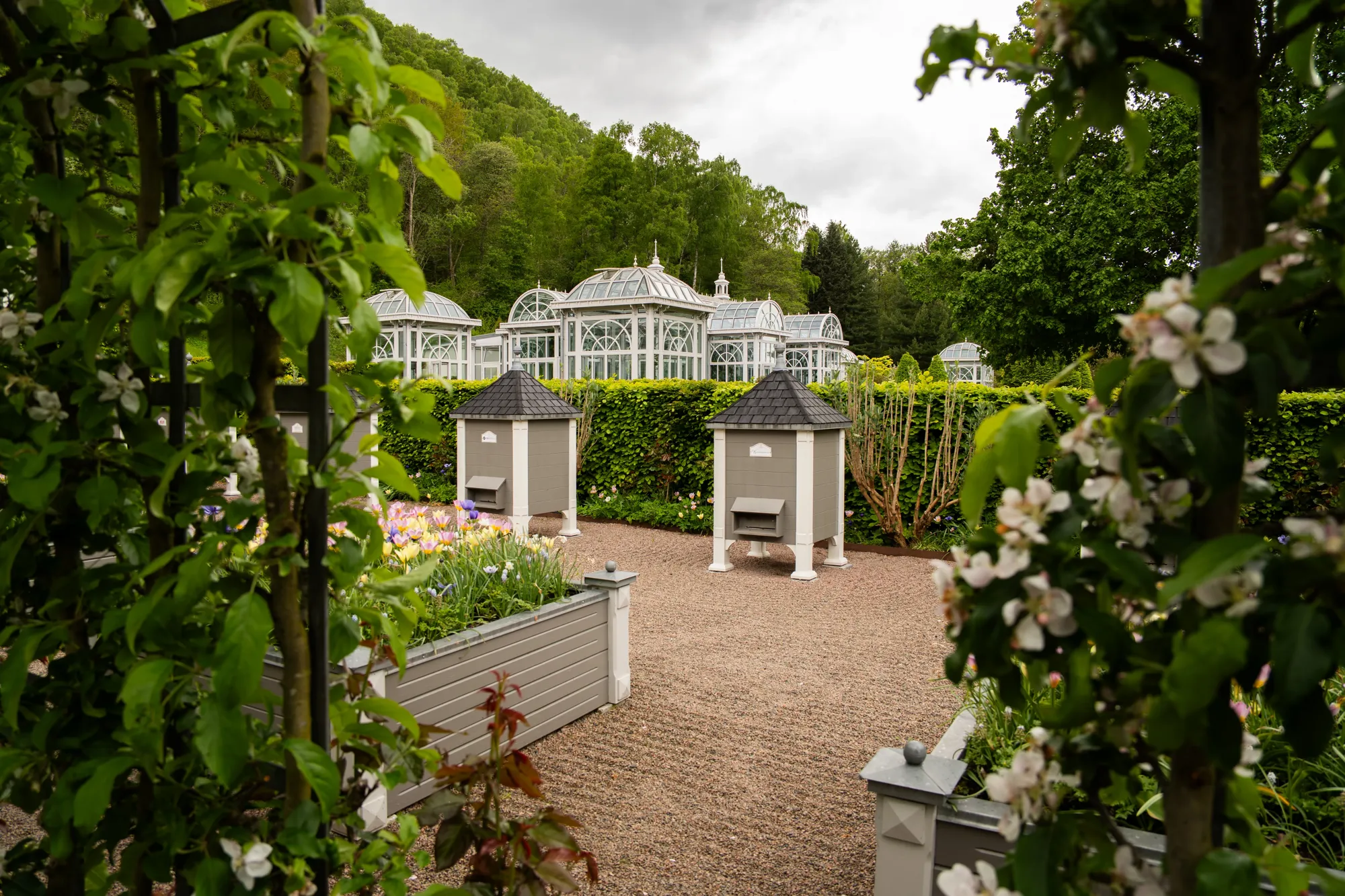
Norrviken's beehive – one of Norrviken's sustainability efforts | Photo: Hannah Sundberg
Forward with cultural heritage at our back
Norrviken has recently been named experience of the year and will represent Skåne in Sweden's tourism award – a confirmation that Maria describes with a clear pride in her voice. The PR work has expanded over the past two years and more and more people are becoming aware of the place.
"Our biggest challenge is getting people here," she says. "We find that once people have been here, they speak well of us. I hope we continue in the same spirit – to manage the cultural heritage but add content and to a greater extent base our work on data and insights rather than just feelings."
It is a balancing act that permeates the entire conversation: respect for what has been and appetite for what is to come. Rudolf Abelins' contrasts live on, not only in the gardens but in the very way Norrviken is run – where the wild and the shaped, the historical and the forward-looking, interact in a whole that is difficult to describe but easy to feel.
When I leave Norrviken and turn back onto the road, the feeling lingers. It is a place that does exactly what it promises: replenishes. And the beautiful thing is that it has been doing so for over a hundred years – and most likely will continue to do so for another hundred years.

The walking paths guide the visitor through a park where each corner has its own character | Photo: Hannah Sundberg

One of Kim Simonsson's moss-covered figures, part of the artwork Moss People that has taken place along Abelins slinga | Photo: Hannah Sundberg

Social areas around the park invite the visitor to pause and be | Photo: Hannah Sundberg
Read more

The entrance to inspiration – at Essem Design, everything starts in the hallway
When you open the door to Essem Design's office in Anderstorp, you are greeted by an atmosphere that feels welcoming, warm, and thoughtful – just like the products they create. The hallway is the company's heart and soul, and at Essem Design, there is an unwavering belief that the first place you encounter should be something truly special. "The hallway is more than just a passage; it is an introduction to everything that awaits," says CEO Robert Bladh as we settle down among beautifully designed coat racks and hooks.

A vision rooted in greenery – Svegros journey towards a self-sufficient Sweden in green
As we turn off the winding country road and approach Färingsö, it feels like we are stepping into another world. The radiant autumn sun bathes the landscape in a golden glow, and the colorful leaves on the trees frame Svegros greenhouse, which majestically spreads out over the expanses. The fresh air fills the lungs, and the gaze meets rows of green, where herbs and lettuce thrive under careful supervision. It is a place where the beauty of nature meets modern technology and where a passion for sustainable cultivation permeates every square meter.

Nature, adventure, and the future – Isaberg creates experiences for everyone
When you turn in towards Isaberg Mountain Resort, you are greeted by a view that breathes adventure and the tranquility of nature. The mountain rises majestically in the background, surrounded by forests and the sparkling lake. The atmosphere is inviting, and everywhere you see signs of the many opportunities that await – bike paths, hiking trails, ski facilities, high ropes course, pump track, disc golf, and the toboggan run that winds down the slope – yes, the list of activities is long. "Here it's about getting closer to nature, whether through adventure or calm activities," says Louise Söderlund, CEO of Isaberg. Nature is the heart of every experience, and Isaberg creates memories for life in every corner of the facility.

The history, craftsmanship, and sustainability – Furhoffs Rostfria unites the past and the future
When you step into Furhoffs Rostfria in Skövde, you are greeted by a unique combination of industrial precision and history. The factory, which has stood strong for 125 years, feels both timeless and innovative. The robust architecture bears witness to the company's development over the years – building by building has emerged, as capital has been available for expansion. Every corner carries traces of the journey the company has made – from a small copper smithy to a leading player in stainless steel.

Gnosjö Automatsvarvning – A motor for the industry's future
At Gnosjö Automatsvarvning, the lathes always stand firm, but it is the people and traditions that drive the company forward. In the heart of the Gnosjö spirit, they have built a business that combines decades of craftsmanship with a striving to be at the forefront technologically. Here, precision is not just a requirement – it is a pride that permeates every detail and every workday.

Ravema – The industrial partner that builds the future
Stepping into Ravema is like entering a world of precision, technical expertise, and strong long-term customer relationships. With over a century of experience, Ravema has grown to become one of the leading industrial partners in the Nordics with a vision not only to provide its customers with products but also with knowledge and support that empower them for the future.

Hooks Herrgård – where every guest feels seen, heard, and cared for
When you turn off the road and the majestic manor facade emerges between gnarled oaks and vast meadows, you immediately understand that this place carries a special history. Here at Hooks Herrgård, visitors have been drawn since Baron Stedt's days in the 18th century. Today, it is the bold investments, the strong family bond, and the constant desire to give that little extra that makes the place live and breathe both tradition and modern comfort.

Farmers' National Federation – a grassroots movement in constant transformation
Behind the work of the Farmers' National Federation (LRF) lies both history, social impact, and a strong belief in the future. Here, everything is about creating conditions for Sweden's green industries to grow, develop, and influence. In a world where conditions are constantly changing, LRF is a voice, a driving force, and a unifying power for what actually puts food on our tables.

Where it all began and still exists – the story of Golvabia
It smells of wood, persistence, and Småland ingenuity when I step into Golvabia in Anderstorp. Here, in a landscape where entrepreneurship is as deeply rooted as the needles in the forest, a family business has not only survived for 75 years but has grown, refined, and developed without ever losing its footing. Literally.

From the apartment to the continent – the story of Beslag Design
When I step through the doors of Beslag Design in Båstad, I am already greeted in the entrance by what the company has built its entire identity around: careful details that just feel... right. Further into the conference room, the assortment spreads out along the walls; handles, knobs, hooks tastefully arranged. We sit down to hear Pontus Eklind, CEO of Beslag Design, tell how the journey began but, above all, where they are headed.

We are live with the web for AmpSociety – part of ChargeNode Group
ChargeNode Group takes an exciting new step forward with the launch of AmpSociety – a new company and brand focused on the future of charging solutions for electric vehicles. AmpSociety is part of ChargeNode Group and is launching the new charging system Amp5. Together with us at Toxic, they have now launched a completely new product and brand website, built on Litium, which lays the foundation for continued success.
2min

Create a powerful e-commerce solution with Umbraco Storefront and Norce e-commerce platform
In a time when e-commerce is developing rapidly, it is crucial to have a flexible, scalable, and user-friendly platform. For companies managing large product catalogs and complex product variations, the combination of Umbraco Storefront and Norce's e-commerce engine is a winning solution.
3min

Effective advertising with Google Ads: Tips for increased visibility and sales
Digital advertising is changing rapidly, and to stay ahead, a strategy that combines data, creativity, and continuous optimization is required. Here, we share important insights and strategies to maximize the effectiveness of your Google Ads advertising, ensuring you get the most out of your budget.
3min

Toxic initiates new collaboration with KABE
We have initiated an exciting collaboration with KABE, one of Sweden's leading manufacturers of caravans and motorhomes. As part of the collaboration, we are developing a new website in Umbraco – a platform that will reflect KABE's premium feel while also making it easier for both visitors and editors to navigate and manage content.
2min

Get more out of your SEO – simple adjustments for better visibility
Do you want more people to find your website? Here are some practical SEO tips that you can start with today to increase your visibility and give your digital presence a boost.
3min

Our team has grown – meet our six new employees!
We are so happy to welcome six new employees to Toxic! Meet Peter, Emma B, Josef, Petter, Linus, and Emma R – a wonderful group that together strengthens our team with valuable skills and drive.
7min

Kläppen Ski Resort chooses Toxic to build a new website in Umbraco Cloud
Kläppen Ski Resort is investing in a new, modern website in Umbraco Cloud to create a more customizable digital experience. The website will provide visitors with the right information at the right time, reflect the facility's offerings and seasonal changes, and integrate with the booking system for a smooth and cohesive customer journey – whether the guest is already on-site in Kläppen or planning their visit.
3min

Umbraco takes home five wins at the CMS Critic Awards 2024!
Five wins at the CMS Critic Awards. What does it say about Umbraco – and about the CMS market in general? We spoke with Daniel Andersson, Tech Lead at Toxic, to get his perspective on why Umbraco continues to dominate and what it means for companies looking for the right platform.
3min

How did Swedish e-commerce perform in 2024 – and what lies ahead?
The E-barometer 2024 from PostNord shows that Swedish e-commerce has turned upward. After two years of decline, revenue increased by 5% to 140 billion kronor. The report offers more than just numbers – it highlights trends that shape the future of e-commerce. In this blog post, we highlight some of the year's most important insights and a glimpse of what lies ahead.
2min

How to build a profitable B2B business digitally – insights from Nordic Digital Commerce 2025
B2B e-commerce is no longer a question of "if" but "how". In Lithium's report Nordic Digital Commerce in B2B 2025, it is clearly stated that digital channels are not just a way to streamline internal processes, but above all a way to improve customer relationships and create growth. Here, Oscar Salomonsson, business area manager E-commerce at Toxic, shares concrete advice for creating a profitable digital B2B business in 2025.
3min

Switching from Optimizely to Umbraco – why more companies are choosing to make the move
Are you wondering if your current CMS is worth the cost? You are not alone. More and more companies are reviewing whether they are really using all the functionality they are paying for and are choosing to switch from licensed platforms like Optimizely to open source alternatives like Umbraco. Kalle Ekstrand, founder of Toxic and sales manager, explains why this step often becomes a boost for both the team and the business.
3min