
Umbraco + AI: What exists today and what is on the way?

News
7 min
News
7 min
To say that AI development is progressing at a frightening pace may not be sticking your neck out directly. New models are coming almost every day, and the development does not seem to be slowing down anytime soon. But how can one implement and benefit from it in Umbraco? We will clarify that in this post!
When we wrote about Umbraco 17 (blog post 1, blog post 2) and its release last year, we mentioned Umbraco MCP as one of the major new features. Since then, quite a lot has happened, and Umbraco now has a much broader and clearer strategy for how AI should become part of the platform.
Umbraco divides this into two different areas:
- AI in Umbraco is about how we can use AI features directly in the editor experience and on the website. Everything from generating alt text to semantic content search.
- Umbraco in AI is the other way around. It’s about making Umbraco accessible to the AI tools we already use, such as ChatGPT, Claude, GitHub Copilot and other AI tools.
Let’s dig a little deeper!
AI in Umbraco
Umbraco’s philosophy around AI is that the CMS and the AI layer should remain separate. That’s why Umbraco has created something called Umbraco AI. It isn’t a ready-made AI feature in itself, but rather a shared layer that other AI features can build on.
A major advantage of Umbraco AI is that the solution isn’t tied to a specific model or AI provider. You can use models from OpenAI, Anthropic and Google, for example, and switch providers without having to rebuild the rest of the AI solution. And the best part? Umbraco AI itself is free and open source! The main cost instead comes from the API calls made to the models.
The basic idea is that the CMS itself should remain stable while the AI layer on top can evolve quickly. Pretty smart, considering an AI model can feel old and outdated just weeks after its release. To standardize how AI is used within Umbraco, functionality has been built around this, including Profiles, Context and Guardrails.
With Context, you can define your company’s tone of voice, writing guidelines, target audiences and other instructions that are useful for the AI to know. Profiles can then be created for different purposes. Your privacy policy, for example, probably shouldn’t use the same playful tone as the rest of the website, while your “Work with us” page probably shouldn’t sound overly legal and formal.
With Governance and Guardrails, you can set clear rules for the information sent both to and from the AI. For example, you could prevent the AI from using words such as WordPress, Sitevision and Optimizely on a page about Umbraco. You can also make sure certain sensitive information is blocked so that it isn’t sent to AI models at all.
So, what has been built on Umbraco AI?
Umbraco AI Prompt
With Umbraco AI Prompt, you can add predefined actions at field level. Let’s say you have a summary field on a content page. You can add a button next to the field that automatically generates a summary based on the text in the main content field.
Umbraco Copilot
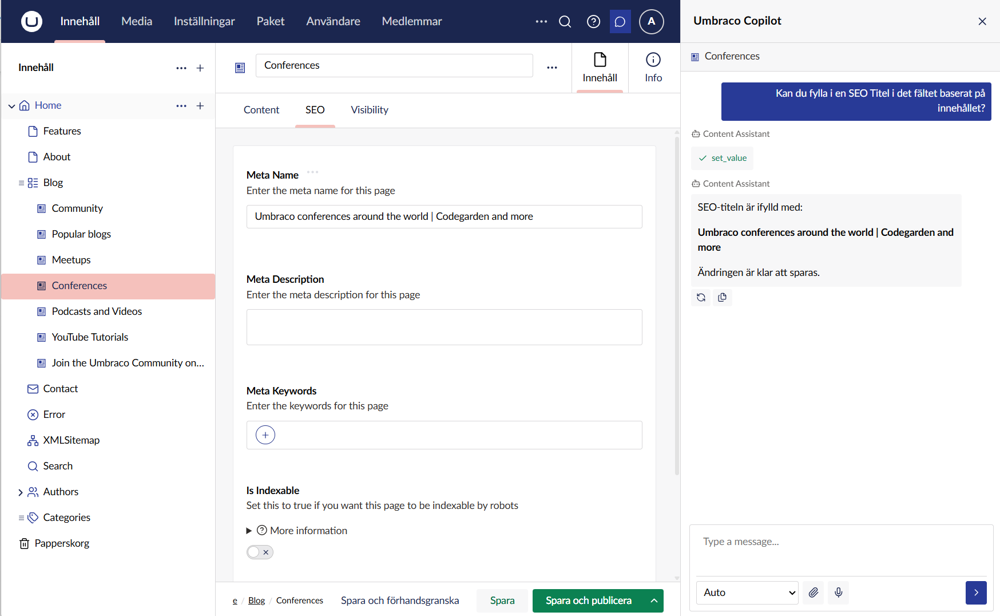
Wish you had a little AI chat window on the side to help you while working with content in the Umbraco backoffice? That’s where Umbraco Copilot comes in. And the best part? It knows which page you’re on and understands the content and structure of that page. Using its other tools, it can also find and work with content from other parts of the website.
It can even make changes directly to the content on the page the editor is working on. For example: “Can you shorten the introduction and make it a little more sales-focused?” or “Can you fill in the SEO title and SEO description based on the content on this page?”
Umbraco Copilot Workspace
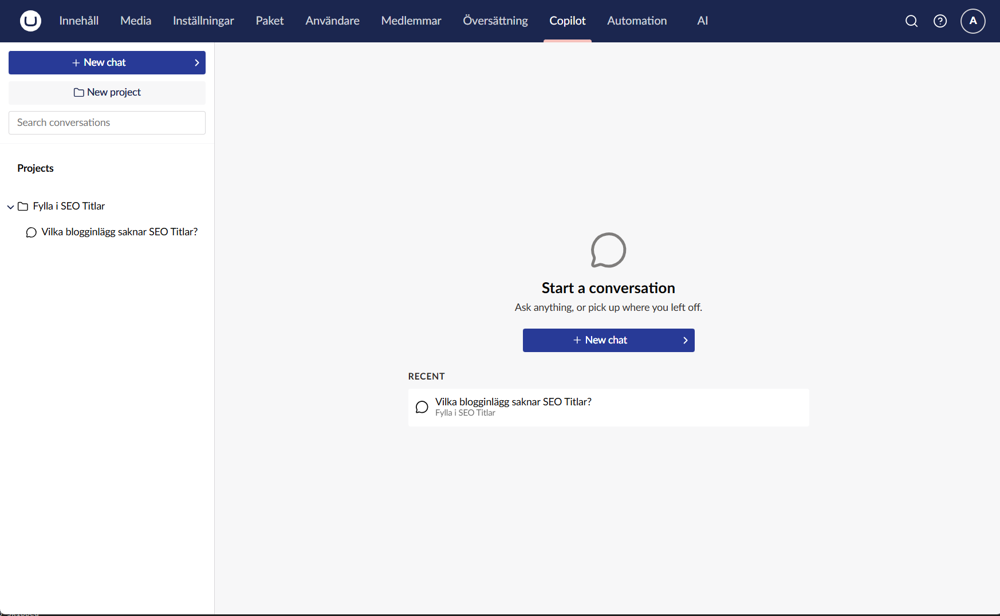
The next step is what’s called “Copilot Workspace”.
Instead of having the chat assistant sitting in the corner, it gets its own dedicated section in the backoffice. The focus here is more on larger tasks and working across multiple pages. It includes features such as chat history and Projects, where you can give the AI additional context and instructions.
At the time of writing, Copilot Workspace is available as a Release Candidate, meaning the feature is close to a full release but is still being tested.
Umbraco Knowledge Sets
Knowledge Sets let you give the AI additional knowledge and instructions it can use while working. This could, for example, include documentation and instructions related to an installed package. That way, the AI doesn’t have to guess how different parts of the solution work.
Umbraco AI Search
A traditional search is good at finding exactly what you type, but not much beyond that. With AI-powered semantic search, users can get relevant results based on the meaning behind their search, even when the exact same words aren’t used in the content. This means synonyms and similar phrasing don’t cause the same problems as they do with traditional text search.
That’s why Umbraco has developed Umbraco.AI.Search, where content is indexed for semantic search. This can improve the user experience and make it easier for visitors to find the content they’re looking for.
Umbraco.AI.Search is currently in beta, which means it’s available to test but is still under active development.
Umbraco Automate + AI
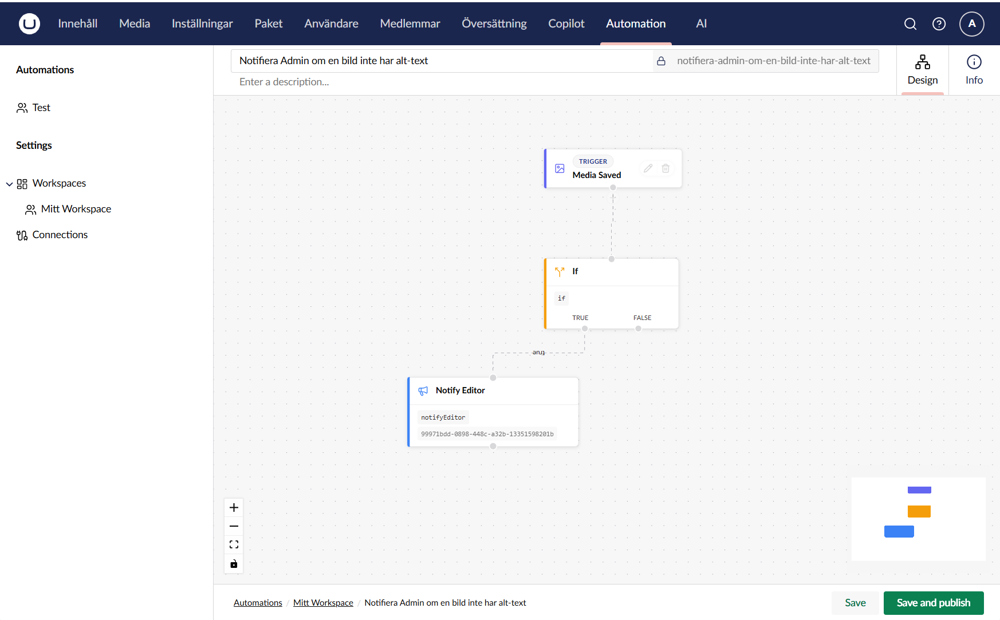
Another perfect use case for AI is Umbraco Automate. Automate is a package developed by Umbraco for building automated workflows using triggers and actions. And AI can be added to those workflows too.
For example, why not automatically let AI generate alt text when a new image is uploaded to the Umbraco media library? Or ask AI to summarize what has changed when an editor publishes new content and then send that summary as a Slack message? Or automatically create a draft English version whenever new Swedish content is published? The possibilities are endless!
The AI integration with Automate is still in alpha and therefore at an early stage of development.
Umbraco Engage.AI
Umbraco’s marketing package, Umbraco Engage, has also gained the ability to connect with Umbraco AI. With the help of Umbraco Copilot, you can now get assistance identifying which campaign performs best, which pages perform best or how different audiences behave.
Umbraco Engage.AI is currently in public beta, meaning it’s available for public testing but is still being developed and may change.
Build your own
In addition to the existing packages, you can of course build your own solutions on top of Umbraco AI. It’s there as a foundation to build on. So the only limit is your imagination!
Umbraco in AI
Now it’s time to turn things around. Instead of bringing AI into Umbraco, we’ll focus on the opposite: how can we make Umbraco accessible to AI?
Open Source
Another advantage when it comes to AI-assisted development is that Umbraco is open source. Since the source code is open, AI agents can access it and investigate how the CMS actually works instead of relying solely on documentation.
MCP
MCP stands for Model Context Protocol, a term that’s appearing more and more when talking about AI agents. It’s an open standard for how AI agents can connect to different systems and use their tools and data in a structured way. And, of course, Umbraco is one of those systems.
With MCP, Claude, Codex or other AI clients that support MCP can communicate with and perform tasks directly in Umbraco instead of you having to do everything yourself. And there are several MCP servers available.
For developers, there’s the Umbraco CMS Developer MCP, which can be used when developing Umbraco websites. It can, for example:
- Create document types
- Create and update content
- Work with media
- Create Dictionary Items
- Manage data types
- Analyze the structure of an Umbraco installation
Umbraco Forms MCP
There’s also an MCP for Umbraco Forms. It allows an AI agent to work with forms, data sources and submitted form responses, among other things. Forms MCP can also be connected to CMS MCP, allowing an AI agent to work with both content and forms within the same workflow.
Umbraco Commerce MCP
Umbraco Commerce has its own MCP as well. Here, AI agents can work with orders, discounts and analytics data from Commerce, among other things. Commerce MCP is still a Proof of Concept, meaning it’s an early implementation primarily intended to demonstrate what’s possible.
For editors, there’s a customized version called CMS Editor MCP. Instead of focusing on the structure and development of an Umbraco website, it focuses on the content itself. For example, you could ask it to:
“Find all news articles from 2025 that are missing an introduction.” or “Create a draft for a new page based on this brief.”
And the best part? It will also be possible to connect an AI client directly to your Umbraco Cloud project and work with the environment through what’s called Remote MCP in Umbraco Cloud.
The roadmap also includes a Content Delivery MCP, which gives AI read-only access to published content and media through Umbraco’s Delivery API. This means AI tools can analyze and understand what is actually published on the website without being able to change the content.
To sum it up:
- Developer MCP: build and modify Umbraco.
- Editor MCP: work with content.
- Forms MCP: work with forms and submitted responses in Umbraco Forms.
- Commerce MCP: work with data and functionality in Umbraco Commerce.
- Content Delivery MCP: understand published content, read-only.
Umbraco CMS Developer MCP is available today. CMS Editor MCP and Hosted Remote MCP for Umbraco Cloud are currently under development, with Q3 2026 as the target release. Content Delivery MCP is also on the roadmap but currently has no announced release date.
Skills
MCP gives AI agents the tools they need to do things in Umbraco, but they also need to understand how those tools should be used. That’s where Skills come in.
Skills are structured instructions and best practices that help AI agents understand how Umbraco works and how to work with it effectively. Today, there are more than 60 Skills for developing the Umbraco backoffice, with more on the way for areas such as content modeling and general implementation.
AI from two directions
Perhaps the most interesting part isn’t any single AI feature, but the fact that Umbraco is approaching AI from both directions. On the one hand, AI is becoming a natural part of the CMS itself. On the other, Umbraco is becoming accessible to the AI agents and tools we already use.
As you can see, there’s a lot happening in Umbraco when it comes to AI, and new things are being introduced all the time. Exciting times ahead!
Read more

Therefore, you should stop stressing about your AI ranking.
The question arises everywhere: “How do we rank in ChatGPT?” It's a good question because AI search is starting to become an important channel for digital marketing and no one wants to risk falling behind. But before you hire someone who promises to “optimize your AI ranking,” you need to know something. There is no real ranking.
2min

When do organizations need to rebuild or redesign their website?
Many organizations use their website for many years without major changes. This is rarely a problem in itself – a website does not need to be rebuilt just because it is old. The problem arises when the technology, content, or visitors' needs have changed more than the website has managed to keep up. It is not always easy to see where the line is between "this we can fix" and "this requires us to rebuild from scratch." Here are four signs worth taking seriously.
3min

Common problems on large websites and how they can be solved
The larger a website grows, the harder it becomes to manage – both for those who visit it and those who work on it every day. What was once a clear structure with a few sections becomes, over time, hundreds of pages, countless subcategories, and content that has been added in batches over several years without a common plan. The result is rarely noticeable all at once; instead, it sneaks in until one day the visitor can no longer find what they are looking for, while the editor no longer knows where something should be. Now we will go through some of the most common problems on large websites and what usually tends to solve them.
3min

That is why many organizations choose to switch CMS
A CMS, a content management system, is the tool an organization uses to publish and update content on its website. Most organizations chose their CMS a long time ago (often five, ten, or fifteen years ago) and have since built upon it year after year. Over time, it becomes harder to live with the choice one once made. Licenses become more expensive, editors find it increasingly difficult to work in the system, and what once felt flexible starts to feel like a hindrance. Let’s go through some of the most common reasons organizations choose to switch CMS and what they often want to achieve with the change.
3min

What is required of a good IR website?
Trust is what determines how a publicly traded company is perceived by investors, analysts, and shareholders. Much of that trust is built or lost on the web. An IR website (Investor Relations) is the place where investors, analysts, and shareholders turn when they want to understand how the company is doing and where it is headed. For a publicly traded company, the website is not just a communication channel; it is part of how the company fulfills its information obligation to the market. If an IR website is difficult to navigate or lacks the right information, it costs more trust than one might think. In this blog post, we will therefore go through what an IR website actually needs to contain and what distinguishes a good IR website from one that is just there out of obligation.
4min

Ad copy that converts: what actually makes a difference
Most people who want to improve their ads start off wrong. They rewrite headlines, change images, test new CTAs. And sure, that can have an effect, but that's rarely where the big difference lies. When an ad doesn't convert, it's often because something in the chain after the click isn't working. The ad is just the beginning. This is what actually determines whether an ad converts.
3min

Four Swedes were appointed Umbraco MVP 2026. One of them is our colleague Daniel Andersson!
Last week we traveled to Copenhagen for this year's edition of Codegarden, Umbraco's annual conference and the natural gathering point for the entire global Umbraco community. Two days of talks, Umbraco Awards, and that special atmosphere that arises when people who are passionate about the same thing are in the same room. It was there that the news came: our colleague Daniel Andersson was named Umbraco MVP for 2026.
2min

Toxic celebrates 30 years of strong growth, good profitability, and high trust from both customers and employees.
This year, Toxic celebrates 30 years as a digital partner for companies with needs in web, e-commerce, customer portals, system integrations, and digital business solutions. After three decades in an industry that is constantly changing, we continue to grow, with strong results, good profitability, and a high level of trust from both customers and employees.
3min

The self-playing piano in B2B – Read more about the report Nordic Digital Commerce in B2B 2026
The B2B companies in the Nordics have reached a clear turning point. Litium's tenth edition of Nordic Digital Commerce in B2B 2026 shows that 81 percent of the Nordics' B2B companies today enable sales through digital channels, that digital sales on average account for 31 percent of revenues, and that 58 percent plan to increase their budget for digital commerce in the coming year. The discussion is no longer about whether to digitalize sales – but about how to take the next step.
11min

Markvaruhuset chooses Toxic for new e-commerce platform in Litium
Building e-commerce for a player that sells to both businesses and individuals – with different flows, different logic, and high demands for integration with business systems – is a project that places high demands on the right technical partner. Markvaruhuset has chosen Toxic for that assignment.
2min

Fifth time's the charm – we are nominated for the Umbraco Awards 2026!
We are very happy to be nominated once again for the Umbraco Awards. This year we are nominated in the category Best Cloud Solution with our solution for KABE AB.
3min

What is Meta Andromeda and how does it affect your advertising?
Are you advertising on Instagram and Facebook? Then you have probably noticed that the ads don't work quite like they used to. Suddenly, some ads seem to reach the right people while others disappear in the feed. What is behind the change and what does it mean for you as an advertiser? We will clarify that.
4min

Four websites in one solution – new digital platform for Atle
To create a more flexible, scalable, and editor-friendly web environment, Atle has chosen Toxic as a digital partner. Together, we are now developing a new web platform in Umbraco that brings together several companies in a common solution and creates economies of scale in line with the company's growth strategy.
2min

Toxic named Umbraco Contributing Platinum Partner 2025
Toxic continues to strengthen its position within Umbraco and has now been appointed as Umbraco Contributing Platinum Partner 2025 – an international award that highlights partners who actively contribute to developing and strengthening the entire Umbraco ecosystem.
2min

Toxic begins long-term partnership with Qvalify in SEO and Google Ads
Qvalify is one of Sweden's leading companies in ISO certifications, inspections, and assessments. With over 30 years of experience, they help organizations strengthen quality, efficiency, and security through certification of management systems, training, and various types of audits. To increase visibility and create clearer results regarding their training and certifications, Qvalify has chosen Toxic as a long-term partner in SEO and Google Ads.
3min

SEO for B2B – how to reach the right decision-makers in search results
Working with SEO for B2B is a completely different playing field than optimizing for consumers. The decision-making process is longer, more people are involved, and each deal is often worth much more. This means that every click from the right person can be invaluable, while the wrong traffic risks being a waste of time. At Toxic, we work daily with B2B companies and know how to tailor the strategy to reach the decision-makers who can make decisions.
2min

Sebastian Pierre returns to Toxic – as Developer and Consulting Manager
With extensive experience in programming and a clear interest in leadership, Sebastian is now back at Toxic in the role of developer and consulting manager. In this interview, you will get to know him better, hear about his journey into the IT industry, and how it feels to be back at Toxic again.
4min

Toxic enters into partnership with Meson Group for web and PIM on Litium
Meson Group, which is part of Indutrade, is a leading supplier of valves and flow control products to the global marine industry. With headquarters in Laholm, sales offices in Europe and Asia, and a large network of distributors, Meson works with technologically advanced products and extensive information flows. To strengthen its digital presence and create a more scalable management of product data, they have chosen Toxic as a partner to develop a new global website and implement Litium PIM.
3min

How to perform an SEO health check of your website
Just like a car needs maintenance to perform at its best, your website needs to be regularly reviewed. An SEO health check reveals both technical and content-related obstacles that may prevent you from reaching top positions in Google and helps you prioritize the right efforts for better visibility.
2min

Toxic looks back at 2025 – a year filled with energy, development, and highlights
2025 has been a year where much has fallen into place – thanks to brave customers, engaged colleagues, and a shared drive forward. We have launched, celebrated, learned, and developed together, in a time that has required both focus and long-term thinking. As we now summarize the year, we do so with great joy over what we have accomplished – and with even greater curiosity about everything that awaits in 2026. Here are some of the moments that have made 2025 a year to remember at Toxic.
9min

Eight new colleagues and a Toxic that continues to grow
2025 has been a year full of movement at Toxic. New colleagues have joined our teams, taken their place in the projects, and quickly become a part of the culture that makes us who we are.
5min