From the apartment to the continent – the story of Beslag Design


When I step through the doors of Beslag Design in Båstad, I am already greeted in the entrance by what the company has built its entire identity around: careful details that just feel... right. Further into the conference room, the assortment spreads out along the walls; handles, knobs, hooks tastefully arranged. We sit down to hear Pontus Eklind, CEO of Beslag Design, tell how the journey began but, above all, where they are headed.
From Köpmansgatan to all of Europe
Beslag Design was founded in 1972 in Båstad, then as a family business in an apartment on Köpmansgatan in Båstad. The former boys' room was an office and the warehouse was located in the basement two flights down. Stig Bergström started the business, his sons Hans and Björn continued the operations, and today the grandchildren Karl and Jonatan are active in the company. Rillan, one of the very first knobs they developed, is still in the assortment – a small but telling detail about a company that does not replace what works just for the sake of it.
"This company has built itself step by step, all the way from an apartment in Båstad, and the most important strength over the years has always been knowing who we want to be – and just as importantly, who we do not want to be. It sounds simple, but in an industry that is constantly changing, it is actually the hardest of all," Pontus explains.

A selection from the assortment, tastefully arranged in Beslags Design's showroom | Photo: Hannah Sundberg

Mirjam Lewin, Marketing Manager Toxic, Pontus Eklind, CEO Beslag Design and Oscar Salomonsson, Business Developer Toxic | Photo: Hannah Sundberg

The new premises on Bjäre Peninsula accommodate both storage, offices, and a showroom | Photo: Hannah Sundberg
The step into the kitchen industry came early in the company's history and became crucial for Beslag Design's continued journey. It gave the company a position in the part of the home where details actually matter: at the kitchen design, in the meeting with the kitchen seller, in the moment where material choices and design language need to land. That insight has shaped much of how Beslag Design thinks about its business. The product almost always belongs to something larger and therefore must be available right where the decision is made.
The process around e-commerce started in 2015 and was anything but obvious at that time. Many B2B companies in the industry viewed direct sales to consumers with skepticism, sometimes even as a threat to their own reseller relationships. Nevertheless, Beslag Design dared to launch Beslag Online first in Denmark in 2016, followed by Norway and the UK, and then Sweden in 2019. During the same period, Beslag Design continued to expand both geographically and in terms of products, and the new premises were built on Inre kustvägen, where Beslag Design is located today. The digital aspect has since become an integrated part of the business, and the next step is a shared platform in Litium that will gather the entire range and create a modern shopping experience for both resellers and consumers.
"When we started e-commerce, there was very little sales. We learned quickly and realized that it wasn't about choosing between B2B and B2C – it was about being available. Our cornerstone in the entire business model is that we need to be where the products are sold, regardless of the channel," says Pontus.
Today, Beslag Design has a turnover of nearly 300 million kronor, of which e-commerce under the brand Beslag Online accounts for around 75–80 million. Sales occur in Sweden, Norway, Denmark, Finland, the Baltics, and England on the B2B side, while e-commerce has also gone live in Germany, France, and the Netherlands. Norway

The warehouse handles orders to retailers and direct customers in Sweden and Europe | Photo: Hannah Sundberg

Beslag Designs office on the Bjäre Peninsula, with roots in Båstad since 1972 | Photo: Hannah Sundberg

The staff has modern and welcoming facilities to gather in | Photo: Hannah Sundberg
From wholesaler to designer
Perhaps the most important shift in Beslag Design's history has occurred over the past decade, and it is less about numbers and more about identity. The company has transitioned from primarily being a wholesaler of European products to shaping a significant part of its own range. Today, around half of the products are developed in-house, recently gathered under the concept name Beslag Design Signatures.
"We have one leg where we develop completely our own products and one leg where we work with strong partners. One does not exclude the other – on the contrary. By designing ourselves, we build a clear identity and gain control over quality and expression. At the same time, the partnerships give us access to technical expertise that we could not have built up on our own. It is the combination that allows us to offer a complete solution for the entire home," says Pontus.
The process behind a new product often begins with observation rather than with a blank sketchbook. Trade shows, interior magazines, and actual homes. A product council gathers around early ideas where designer Kristian Gunnemo first sketches and then prints the shapes in 3D to be able to hold them in hand and feel how they actually feel. From there, it moves on to material choices and color palette. It takes about eight months before a new product is ready to meet the market.
At the same time, there is a faster route. E-commerce acts as a test lab where form and color can be tested in real conditions, with real data and real customers. It challenges the traditional way of launching within B2B, and it is a strength that Pontus returns to several times during our conversation.
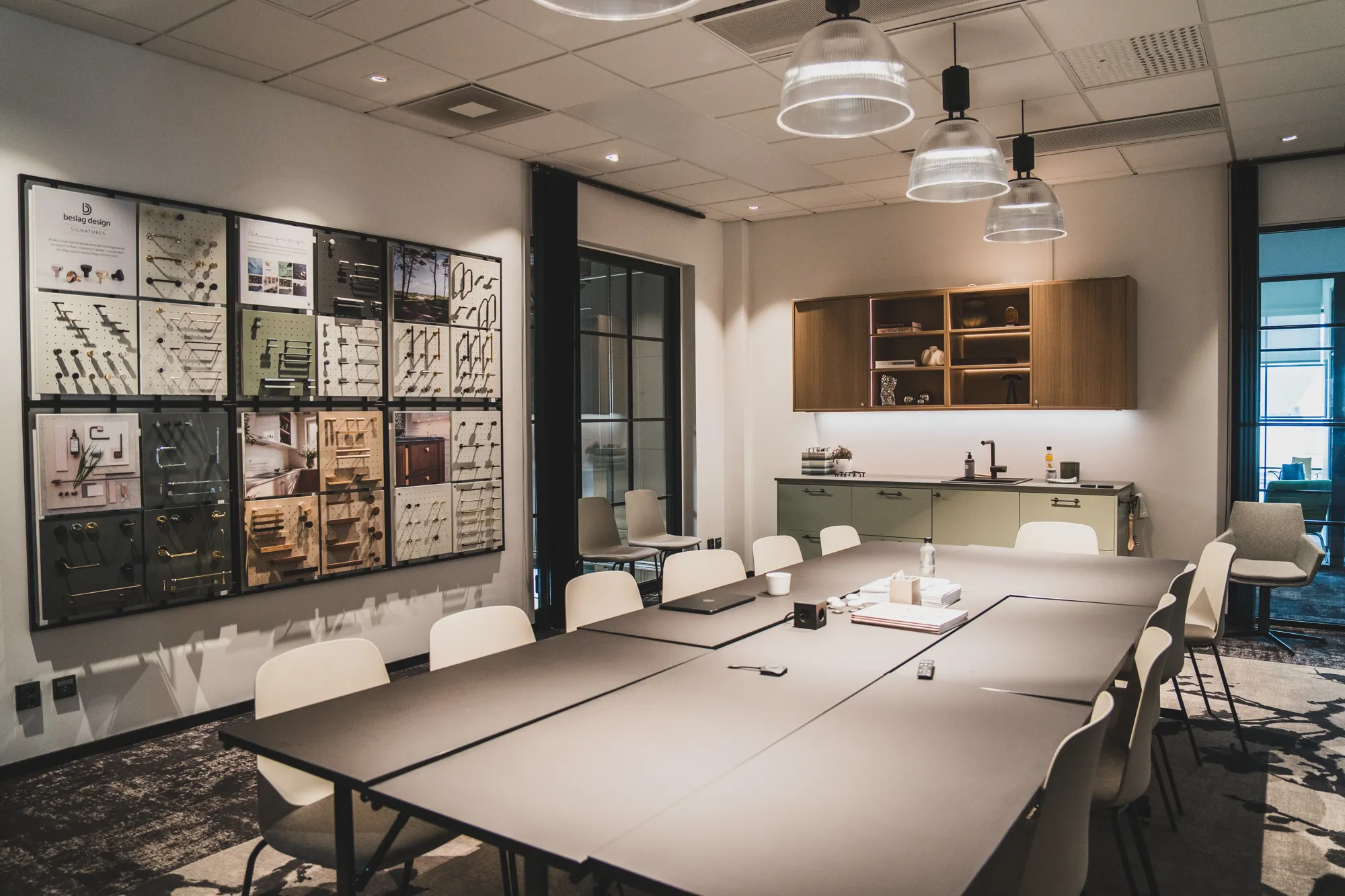
One of Beslag Design's meeting rooms, where the range is naturally integrated along the walls | Photo: Hannah Sundberg
"We never jump on a trend when it appears. We jump on it when we see that it will become commercial. For example, we were early on the matte black design language when it came, but we were not the first. We want to be modern, not trendy,” explains Pontus.
The design is Scandinavian and minimalist at its core, but the range deliberately includes influences from abroad – Danish and Spanish manufacturers complement their own work and add perspectives that Pontus describes as enriching rather than necessary. In areas like lighting, where technical expertise requires deep specialization, they let partners take the lead. Bathroom accessories, on the other hand, are entirely self-designed, and this is an area that has grown in both turnover and pride. The range now extends far beyond handles and knobs and includes lighting, storage, door handles, sinks, faucets, and other products for kitchen and home.
Beslag Design develops its own products but does not manufacture them in its own factory. Production takes place with specialized manufacturing partners, while Beslag Design is responsible for design, product development, range strategy, quality assurance, and packaging. This is a distinction that may sound like a footnote but is actually central to the business model – it allows them to be quick, flexible, and focused on what they are actually best at.

Product development begins with sketch and prototype. Exciting products that cannot be revealed yet are hanging on the walls. | Photo: Hannah Sundberg

Every day, orders are packed for customers in Sweden and Europe | Photo: Hannah Sundberg

Every order is handled with care before it reaches the customer | Photo: Hannah Sundberg
Families rather than individual products
A shift that has become increasingly clear in the range over the past year is the idea of cohesive product families. A handle that goes with a knob, a hook that matches a towel holder, a whole room where the details speak the same design language. The idea is not new in itself, but it has changed how Beslag Design thinks about its entire offering.
"Handles and knobs account for 60 percent of our sales and our money is in kitchen renovations, but we want to be a bigger part of the home than that. We want to be in the hallway, in the bathroom, in the living room and create the details that tie the experience together throughout the home,” states Pontus.
The target audience is those who want a beautiful home and a safe choice. Mid-to-high-end, focusing on material choices and design language rather than the lowest price. The products should withstand the test of time, not just materially but in their expression. It should be just as right to pull that handle in five years as it was the day you installed it.
"We do not work with price as a motivator, but we work with quality and design. That is what we want the customer to associate us with, and that is the promise we must deliver on every day,” says Pontus.

Three sinks in different designs, a selection from a range that extends throughout the home | Photo: Hannah Sundberg
Sustainability that is visible in the material
The sustainability work at Beslag Design is about concrete choices rather than grand declarations. In 2025, the company reduced its emissions by 15 percent through conscious material changes, renewable electricity in its premises, and electric cars. One of the most important transitions right now is the shift to recycled materials in an increasing number of products – a task that requires close collaboration with suppliers and careful traceability throughout the entire chain.
What makes me most curious during the conversation, however, is what lies ahead. Beslag Design is one of the companies in the industry that has come the furthest in making the climate footprint of products visible, with the goal of being able to show a carbon dioxide equivalent per product directly on the website. All metal alloys are tested and evaluated, and the results will be visible and comparable for you as a customer. For a company with premises on the Bjäre Peninsula and roots in an apartment from 1972, this is an ambition level that says more about where they are headed than any revenue figure could.
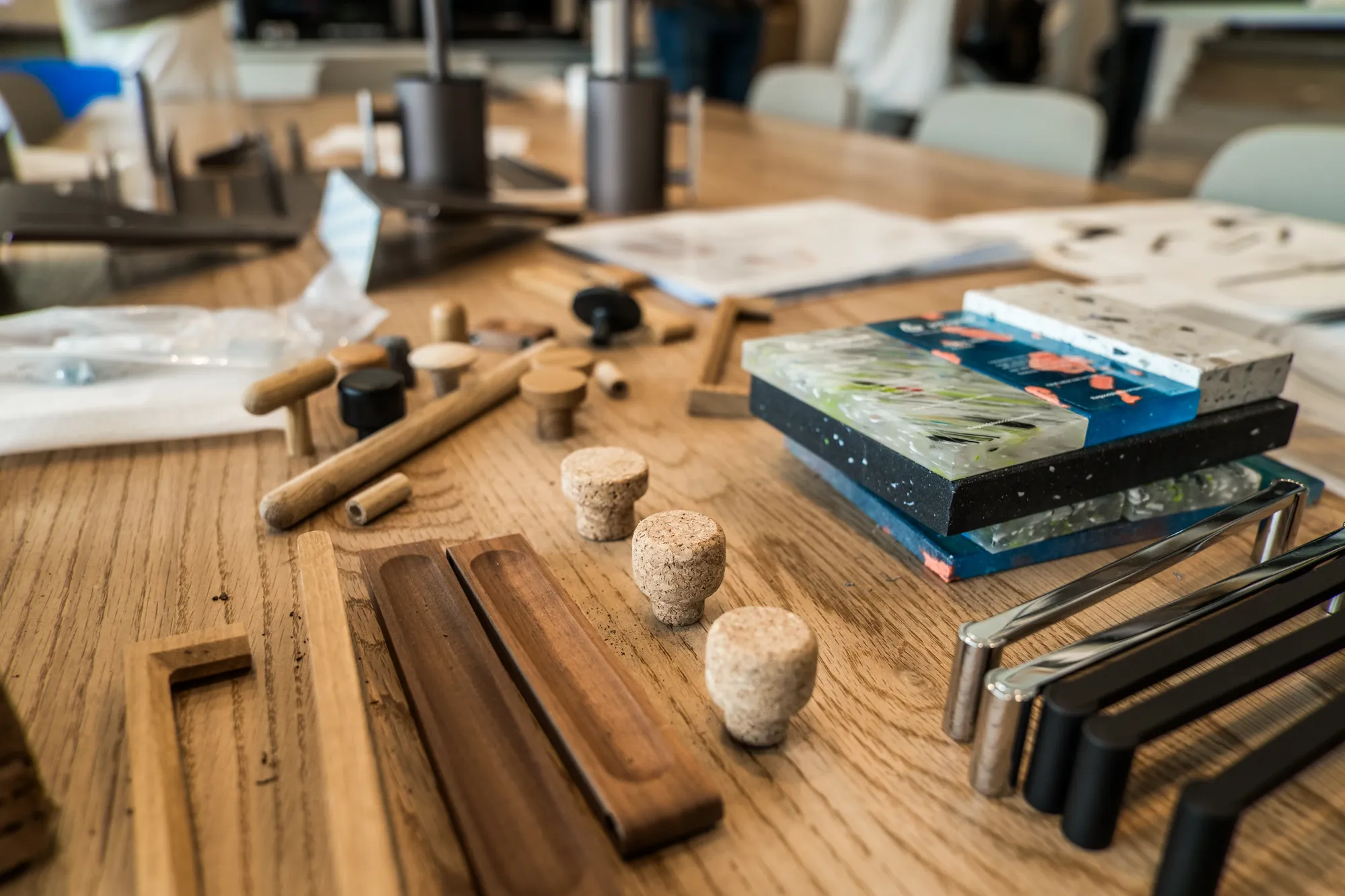
Material under evaluation, part of the transition to recycled raw materials in the assortment | Photo: Hannah Sundberg
Forward with feet in Båstad
Since 2024, Beslag Design is owned by the publicly listed group Volati. The goal that comes with the new ownership structure is clearly stated: revenue should double within five years. However, when Pontus talks about growth, it is not about spreading thin or chasing market shares for the sake of it. It is about digging where they stand and taking one step at a time.
"We don't believe in looking at everything at once," he says. "We believe in staying close to the core business. Doing a proper analysis of what we should sell and how we should sell it." Internationalization should happen in a controlled manner, and new markets will be established only when the conditions are right. The goal is to build relevance first and then scale up.
The product portfolio should continue to broaden, not only through in-house design but by exploring complementary products that strengthen the position in more rooms and environments. The product roadmap extends five years ahead and includes both new categories and new European markets. The digital development runs parallel to all of this. Together with Toxic, the platform in Litium is already under development, and the ambition is for the B2B side to function as a sharp e-commerce in itself and free up time for what is still crucial: building relationships and adding real value to the business.
"The digital part is our big thing moving forward," says Pontus. "We want our people to do the right things – build relationships and add something, everything else should be solved by technology."

Beslag Designs packaging is 100 percent recyclable, one of many steps in the company's sustainability efforts | Photo: Hannah Sundberg

Beslag Design actively works to make it easy to find the right product, regardless of the channel | Photo: Hannah Sundberg

The office environment reflects the same attention to detail that permeates the entire operation | Photo: Hannah Sundberg
Friday evening at home
When I ask Pontus what the ultimate goal is, the one that drives everything else, he responds with a formulation that is as simple as it is difficult to achieve: "We want to be in people's homes on Friday evenings, not as guests, but as that detail you see in the corner of your eye. When people market us without thinking about it, when they show off their kitchen to friends and someone comments on the handle – then we are right."
It's hard not to be a little moved by that formulation. It captures something that I believe permeates the whole of this company, from Rillan in the product range to the new platform that will carry the next chapter. It's all about being the detail that makes a difference without taking over.
From an apartment on Köpmansgatan to homes across Europe, Beslag Design has built its brand on the same principle that permeates their products: that what is made with care lasts the longest. With recycled materials on the way, self-developed product families in the range, and the whole continent on the map, the journey is far from over. Rather, it is just as Pontus himself expresses it – they want to continue changing homes, one fitting at a time.
Read more

The entrance to inspiration – at Essem Design, everything starts in the hallway
When you open the door to Essem Design's office in Anderstorp, you are greeted by an atmosphere that feels welcoming, warm, and thoughtful – just like the products they create. The hallway is the company's heart and soul, and at Essem Design, there is an unwavering belief that the first place you encounter should be something truly special. "The hallway is more than just a passage; it is an introduction to everything that awaits," says CEO Robert Bladh as we settle down among beautifully designed coat racks and hooks.

A vision rooted in greenery – Svegros journey towards a self-sufficient Sweden in green
As we turn off the winding country road and approach Färingsö, it feels like we are stepping into another world. The radiant autumn sun bathes the landscape in a golden glow, and the colorful leaves on the trees frame Svegros greenhouse, which majestically spreads out over the expanses. The fresh air fills the lungs, and the gaze meets rows of green, where herbs and lettuce thrive under careful supervision. It is a place where the beauty of nature meets modern technology and where a passion for sustainable cultivation permeates every square meter.

Nature, adventure, and the future – Isaberg creates experiences for everyone
When you turn in towards Isaberg Mountain Resort, you are greeted by a view that breathes adventure and the tranquility of nature. The mountain rises majestically in the background, surrounded by forests and the sparkling lake. The atmosphere is inviting, and everywhere you see signs of the many opportunities that await – bike paths, hiking trails, ski facilities, high ropes course, pump track, disc golf, and the toboggan run that winds down the slope – yes, the list of activities is long. "Here it's about getting closer to nature, whether through adventure or calm activities," says Louise Söderlund, CEO of Isaberg. Nature is the heart of every experience, and Isaberg creates memories for life in every corner of the facility.

The history, craftsmanship, and sustainability – Furhoffs Rostfria unites the past and the future
When you step into Furhoffs Rostfria in Skövde, you are greeted by a unique combination of industrial precision and history. The factory, which has stood strong for 125 years, feels both timeless and innovative. The robust architecture bears witness to the company's development over the years – building by building has emerged, as capital has been available for expansion. Every corner carries traces of the journey the company has made – from a small copper smithy to a leading player in stainless steel.

Gnosjö Automatsvarvning – A motor for the industry's future
At Gnosjö Automatsvarvning, the lathes always stand firm, but it is the people and traditions that drive the company forward. In the heart of the Gnosjö spirit, they have built a business that combines decades of craftsmanship with a striving to be at the forefront technologically. Here, precision is not just a requirement – it is a pride that permeates every detail and every workday.

Ravema – The industrial partner that builds the future
Stepping into Ravema is like entering a world of precision, technical expertise, and strong long-term customer relationships. With over a century of experience, Ravema has grown to become one of the leading industrial partners in the Nordics with a vision not only to provide its customers with products but also with knowledge and support that empower them for the future.

Hooks Herrgård – where every guest feels seen, heard, and cared for
When you turn off the road and the majestic manor facade emerges between gnarled oaks and vast meadows, you immediately understand that this place carries a special history. Here at Hooks Herrgård, visitors have been drawn since Baron Stedt's days in the 18th century. Today, it is the bold investments, the strong family bond, and the constant desire to give that little extra that makes the place live and breathe both tradition and modern comfort.

Farmers' National Federation – a grassroots movement in constant transformation
Behind the work of the Farmers' National Federation (LRF) lies both history, social impact, and a strong belief in the future. Here, everything is about creating conditions for Sweden's green industries to grow, develop, and influence. In a world where conditions are constantly changing, LRF is a voice, a driving force, and a unifying power for what actually puts food on our tables.

Where it all began and still exists – the story of Golvabia
It smells of wood, persistence, and Småland ingenuity when I step into Golvabia in Anderstorp. Here, in a landscape where entrepreneurship is as deeply rooted as the needles in the forest, a family business has not only survived for 75 years but has grown, refined, and developed without ever losing its footing. Literally.

Where the ridge meets the sea – the story of Norrvikens trädgårdar
There are places that do something to you even before you understand why. Norrvikens trädgårdar on the Bjäre Peninsula is one such place. Here, where Hallandsåsen meets the sea and a favorable microclimate allows the impossible to bloom, a man's vision has lived on for over a hundred years; through storms, crop failures, changes of ownership, and a period of decline that almost became the end – but it did not.

We are live with the web for AmpSociety – part of ChargeNode Group
ChargeNode Group takes an exciting new step forward with the launch of AmpSociety – a new company and brand focused on the future of charging solutions for electric vehicles. AmpSociety is part of ChargeNode Group and is launching the new charging system Amp5. Together with us at Toxic, they have now launched a completely new product and brand website, built on Litium, which lays the foundation for continued success.
2min

Create a powerful e-commerce solution with Umbraco Storefront and Norce e-commerce platform
In a time when e-commerce is developing rapidly, it is crucial to have a flexible, scalable, and user-friendly platform. For companies managing large product catalogs and complex product variations, the combination of Umbraco Storefront and Norce's e-commerce engine is a winning solution.
3min

Effective advertising with Google Ads: Tips for increased visibility and sales
Digital advertising is changing rapidly, and to stay ahead, a strategy that combines data, creativity, and continuous optimization is required. Here, we share important insights and strategies to maximize the effectiveness of your Google Ads advertising, ensuring you get the most out of your budget.
3min

Toxic initiates new collaboration with KABE
We have initiated an exciting collaboration with KABE, one of Sweden's leading manufacturers of caravans and motorhomes. As part of the collaboration, we are developing a new website in Umbraco – a platform that will reflect KABE's premium feel while also making it easier for both visitors and editors to navigate and manage content.
2min

Get more out of your SEO – simple adjustments for better visibility
Do you want more people to find your website? Here are some practical SEO tips that you can start with today to increase your visibility and give your digital presence a boost.
3min

Our team has grown – meet our six new employees!
We are so happy to welcome six new employees to Toxic! Meet Peter, Emma B, Josef, Petter, Linus, and Emma R – a wonderful group that together strengthens our team with valuable skills and drive.
7min

Kläppen Ski Resort chooses Toxic to build a new website in Umbraco Cloud
Kläppen Ski Resort is investing in a new, modern website in Umbraco Cloud to create a more customizable digital experience. The website will provide visitors with the right information at the right time, reflect the facility's offerings and seasonal changes, and integrate with the booking system for a smooth and cohesive customer journey – whether the guest is already on-site in Kläppen or planning their visit.
3min

Umbraco takes home five wins at the CMS Critic Awards 2024!
Five wins at the CMS Critic Awards. What does it say about Umbraco – and about the CMS market in general? We spoke with Daniel Andersson, Tech Lead at Toxic, to get his perspective on why Umbraco continues to dominate and what it means for companies looking for the right platform.
3min

How did Swedish e-commerce perform in 2024 – and what lies ahead?
The E-barometer 2024 from PostNord shows that Swedish e-commerce has turned upward. After two years of decline, revenue increased by 5% to 140 billion kronor. The report offers more than just numbers – it highlights trends that shape the future of e-commerce. In this blog post, we highlight some of the year's most important insights and a glimpse of what lies ahead.
2min

How to build a profitable B2B business digitally – insights from Nordic Digital Commerce 2025
B2B e-commerce is no longer a question of "if" but "how". In Lithium's report Nordic Digital Commerce in B2B 2025, it is clearly stated that digital channels are not just a way to streamline internal processes, but above all a way to improve customer relationships and create growth. Here, Oscar Salomonsson, business area manager E-commerce at Toxic, shares concrete advice for creating a profitable digital B2B business in 2025.
3min

Switching from Optimizely to Umbraco – why more companies are choosing to make the move
Are you wondering if your current CMS is worth the cost? You are not alone. More and more companies are reviewing whether they are really using all the functionality they are paying for and are choosing to switch from licensed platforms like Optimizely to open source alternatives like Umbraco. Kalle Ekstrand, founder of Toxic and sales manager, explains why this step often becomes a boost for both the team and the business.
3min